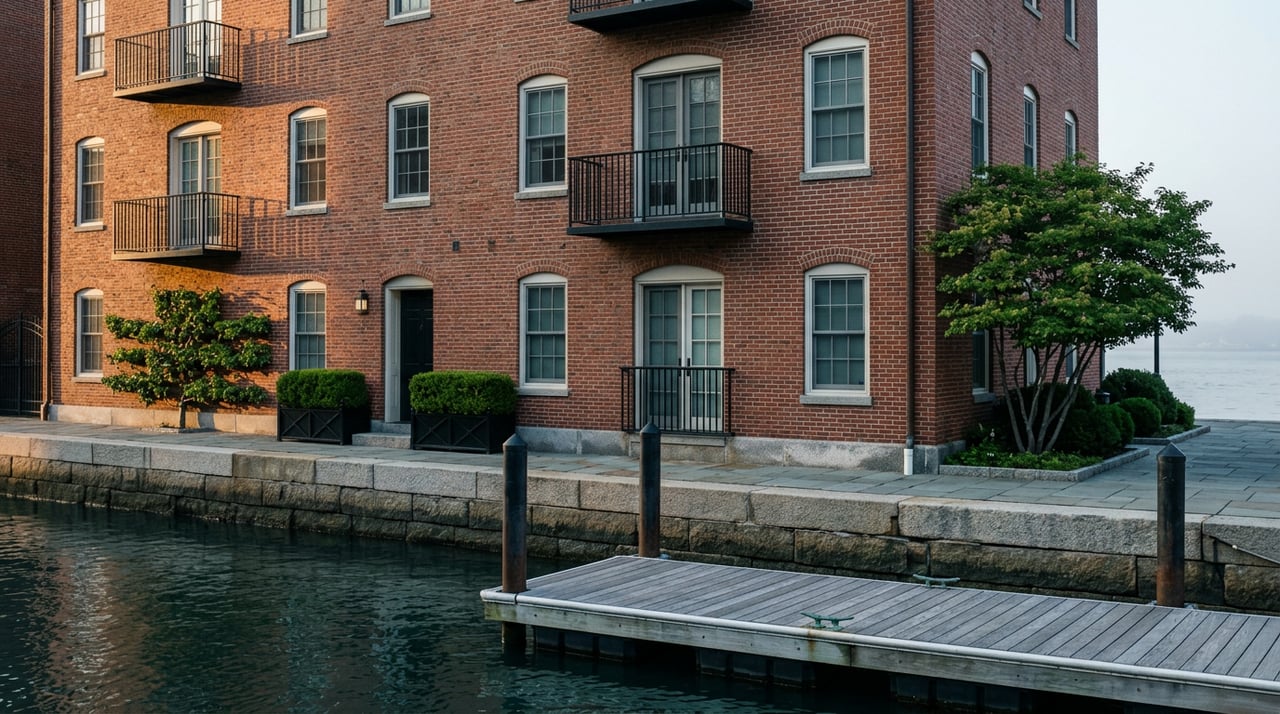
A listing for a three-bedroom condo at 3 Battery Wharf includes a sentence that most Boston condo disclosures never need: the seller owns a private boat slip and will sell it with the unit for $100,000. Down the hall, another unit in the same building notes that a 50-foot slip is available for purchase, no price stated, negotiate separately. These are not marketing flourishes. They are actual disclosures on active Boston listings this year, and they point to something buyers comparing Boston Harbor condos tend to miss: not all "dock access" is the same asset, priced the same way, or worth the same thing over time.
Three-quarters of a mile south, at the Boston Harbor Hotel's Rowes Wharf, a boater pulls up to a nearly identical stretch of water and pays by the foot, by the day. No deed. No resale value. No line item on anyone's condo closing statement. Same harbor, same general idea of parking a boat near your front door, two completely different financial instruments.
If you're comparing condo buildings along Boston's Waterfront and one of them mentions a marina, a dock, or boat storage, the question worth asking isn't "does it have water access." It's "which of these two models is it."
What Battery Wharf is actually selling
The Residences at Battery Wharf is a 104-unit building split across three towers at 2, 3, and 4 Battery Wharf on Commercial Street, built in 2008 and attached to what is now the Battery Wharf Hotel. Several current and recent MLS disclosures for units in the building describe a specific, purchasable slip tied to a specific residence. One 2026 listing for a three-bedroom, two-and-a-half bath unit states plainly that the seller's private boat slip will convey with the sale for $100,000. A separate unit's disclosure describes a 50-linear-foot slip available for purchase alongside deeded storage and garage parking, the same category of asset as the parking space or the storage cage: something with a price tag, a size, and an owner.
That structure matters because it means the slip behaves like real property attached to the unit rather than a perk that disappears when your lease or your hotel stay ends. It can be priced. It can be sold with the condo or, based on how these disclosures read, potentially sold separately from it. It sits on the closing statement the same way a deeded parking spot does in other Boston buildings, an add-on with its own value that a buyer either wants or doesn't, but one that belongs to the unit rather than to whoever happens to be standing on the dock that week.
What the marina next door is actually renting
The Marina at Rowes Wharf, attached to the Boston Harbor Hotel and managed by JLL, runs on a completely different logic. It has 38 total slips, 19 of them transient and 19 seasonal, big enough to handle yachts up to 200 feet. According to the marina's own published rates, dockage runs $5 to $7 per foot, with power metered separately: $35 a day for 30 amps, $45 a day for 50 amps, $105 a day for 100 amps.
Run the math on an ordinary boat and the picture gets clearer fast. A 40-foot boat docking for a night at Rowes Wharf, before power, runs somewhere between $200 and $280. Nobody who pays that owns anything afterward. It's a hospitality charge, closer to a hotel room rate than a real estate transaction, which makes sense given the marina exists as an amenity of a five-star hotel, not as a piece of the building's condominium structure. Boston Harbor Hotel markets it to "sailing guests" as a privilege of staying there, not a right that transfers with any residence.
Here's the comparison side by side:
| Battery Wharf slip | Marina at Rowes Wharf | |
|---|---|---|
| Structure | Purchasable, tied to a specific unit | Rented by the day or season |
| Price basis | ~$100,000 in one 2026 disclosure; another unit lists a 50-ft slip for separate purchase | $5–$7 per foot per day, plus metered power |
| Ownership | Conveys with or alongside the condo | None. Access ends when you stop paying |
| Who it's for | Condo owners in the building | Hotel guests and transient boaters |
Neither structure is better in the abstract. They're built for different buyers. But they are not interchangeable, and a listing that simply says "marina access" without specifying which model it is telling a buyer something incomplete.
Why the difference should change how you read a listing
If you're comparing two Waterfront-adjacent condos and one mentions a boat slip, the first question is whether that slip is deeded or assigned to the unit, or whether it's really describing proximity to a public or hotel-run marina where any boater with a credit card can reserve space. The first is an asset you're buying. The second is a nearby convenience you might get to use on the same terms as a hotel guest.
That distinction shows up at resale too. A slip that conveys with the unit, the way the Battery Wharf disclosures describe, has its own value that a buyer can weigh against the condo's price per square foot, similar to how a deeded parking space gets valued separately from the living space in plenty of Boston buildings. A slip you can only access by reserving and paying a day rate contributes nothing to the unit's equity. It's a lifestyle detail, not a balance sheet item.
For anyone actually shopping for a slip separately from a condo purchase, the comparison also frames what a fair price looks like. A $100,000 purchase price for a 50-foot slip needs to be judged against what renting equivalent space would cost over years of ownership, not against a single night's transient rate, since the whole point of buying is avoiding that per-day exposure indefinitely.
The other blurry line: is Battery Wharf even "Waterfront"
There's a second wrinkle worth knowing if you're using neighborhood comparisons to size up a purchase. Battery Wharf's own marketing can't quite agree on where it sits. Some listing descriptions place it in Boston's Waterfront neighborhood outright. Others describe it as sitting in the Waterfront section of the historic North End, or simply as a North End building on Commercial Street that happens to face the harbor.
That's not a typo repeated across multiple sources. It's a real seam in how Boston's harbor-facing blocks get categorized, and it matters more than it should when someone is comparing median prices or price-per-square-foot figures between "North End" and "Waterfront" as if those were two clean, separate columns. A building with a marina, a five-star hotel, and some of the highest price points on the harbor can get counted in either bucket depending on which site you're reading. Before leaning too hard on a neighborhood-level comparison, it's worth checking which buildings are actually included in each figure.
Two questions worth asking before you write an offer
If a listing mentions a boat slip, is it deeded to the unit or simply nearby? Ask directly whether the slip is owned, assigned as exclusive use, or just a reference to a public marina within walking distance. The disclosure should say which, and if it doesn't, that's worth clarifying before you factor any value into your offer.
Does the building's marina serve owners, or does it serve hotel guests? Some harbor buildings sit next to hotel-run marinas that exist to serve paying guests, not residents. Living next to one doesn't grant you priority access or a lower rate. Confirm what a building's governing documents actually promise owners, rather than assuming proximity equals privilege.
Boston Harbor's dock space along the Waterfront looks similar from the water. It is not priced the same way twice. Knowing which model you're looking at, before you fall for the idea of parking a boat outside your own front door, is the difference between buying an asset and renting a very nice view.
If you're weighing a Waterfront or North End purchase and want a second set of eyes on what a listing's amenities actually convey, True North Boston Realty has spent years reading the fine print on buildings exactly like this one. Contact Us.